Commercial Door Repair Services in Sydney
Commercial doors are subjected to significantly higher levels of use than residential doors, particularly in high-traffic environments such as offices, retail premises, restaurants, schools and shopping centres. Repeated opening and closing cycles place increased loads on hinges, pivots, rollers, closers, locks, handles, tracks and other operating hardware, making wear, misalignment and component failure more common over time.
+ Read More
Many commercial doors are also larger, heavier and more complex than standard residential doors. Oversized glazed doors, large sliding panels, bi-fold systems and pivot doors can place substantial loads on their hardware and require specialist equipment, tools and handling procedures to safely remove, adjust and repair them.
Changes in door operation should be addressed promptly. Increased resistance, dragging, binding, uneven movement, excessive noise, difficulty closing or locking, or changes in alignment can indicate developing hardware issues. Continuing to operate a door with a failing component can place additional load on other parts of the system, potentially turning a relatively straightforward hardware repair into a more extensive and costly repair involving multiple components or, in some cases, complete hardware or door replacement.
Safety is also a critical consideration with commercial doors. Hardware failure, deterioration or incorrect adjustment can affect the stability, movement and controlled operation of a door. In certain systems, failure of hinges, pivots, rollers can create a risk of the door or door panels becoming unstable or separating from its supporting hardware or tracks.
Our approach is to assess the complete door system rather than simply replace the failed component. We inspect the condition and operation of the hardware, door alignment, fixings, tracks, pivots, hinges and surrounding components to identify the underlying cause of the problem and determine the most appropriate repair solution.
Lift-Assist Equipment & Safe Handling

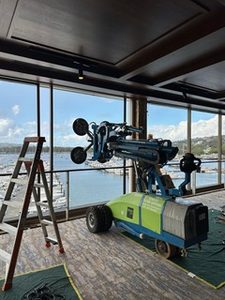
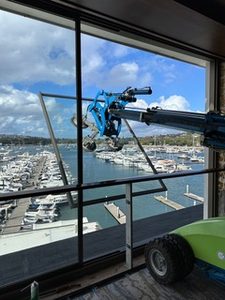
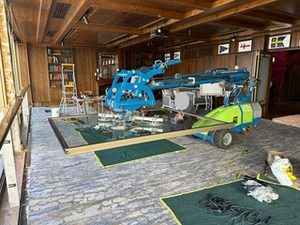
Oversized commercial doors, such as frameless glazed panels, pivot, sliding and bi-fold systems can be difficult to safely manoeuvre using manual handling alone. Their size and weight can make them difficult to safely handle, particularly when manoeuvring heavy doors in tight or restricted access points or working within confined areas.
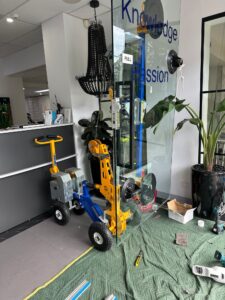
The appropriate handling method is assessed for each job based on the door’s size, weight, configuration, access conditions and the nature of the repair. Where specialist lift-assist equipment is appropriate, we prefer this method to manual handling alone to provide a more controlled process and help protect personnel, the door and the customer property. The equipment is designed to assist with removing the door from its position, securely supporting and holding the door while repairs are undertaken, and then reinstalling the door once the work is complete.
Pivot Door Repairs
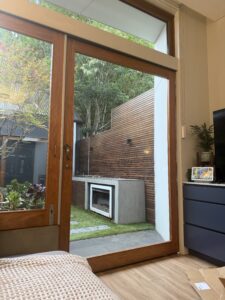
Pivot doors are commonly used for oversized residential entry doors, architectural applications and high-traffic commercial entrances. Unlike conventional hinged doors, pivot doors rotate around a vertical pivot axis, with the door’s weight transferred through pivot hardware located at the top and bottom of the door. This configuration allows larger and heavier doors to be installed while maintaining a clean, streamlined appearance.
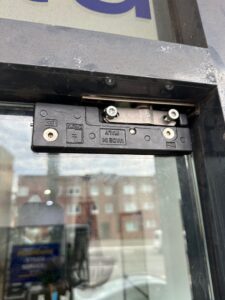
Pivot doors can incorporate a range of different systems, including hydraulic floor springs, concealed overhead or transom closers, non-hydraulic pivot sets, concealed pivot systems and patch-fitted systems for frameless glass doors. The hardware selected is dependent on the door’s size, weight, configuration, frequency of use and required operating characteristics.
A pivot door that becomes difficult to operate, drops, scrapes, slams, fails to close correctly or no longer latches properly may have an issue with the pivot hardware, closer, alignment, fixings or another component within the operating system. Hydraulic floor springs can also develop oil leaks or lose their ability to control the door’s closing and latching action.
Pivot door repairs require more than simply replacing a failed component. The complete operating system needs to be assessed to identify the cause of the problem and determine whether the existing hardware can be repaired, adjusted or requires replacement.
For larger and heavier pivot doors, safe handling is also a critical part of the repair process. Where required, specialist lift-assist equipment is used to complete these types of repairs. Replacement pivot hardware also needs to be correctly matched to the door. The replacement needs to be appropriate for factors including:
- Door weight
- Door dimensions
- Door material
- Frequency of use
- Required opening angle
- Closing requirements
- Hold-open requirements
- Pivot location
- Existing floor preparation
- Existing top pivot arrangement
- Door clearances
- Commercial or residential application
Manufacturers specify different pivot systems according to door weight and width, and choosing an underspecified system can create operational and durability problems. Where possible, we recommend retaining the existing system or using compatible like-for-like hardware. Substituting a different or lower-cost system may require modifications that can result in additional installation costs.
Our technicians assess the pivot system as a complete assembly rather than simply replacing the component that has failed. This allows us to identify the underlying cause of the problem and determine the most appropriate repair solution.
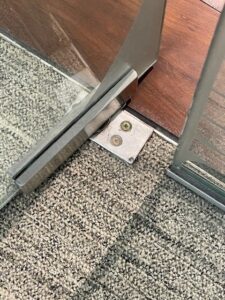
Floor Springs
Floor springs vary significantly in design, quality, capacity and price. While two floor springs may appear similar externally, they can have very different performance specifications and may not be interchangeable.
Factors that influence the suitability and cost of a floor spring include the weight and size of the door, frequency of use, closing and latching control, hold-open functionality, adjustment range, durability and the overall quality of the hydraulic mechanism. Commercial-grade floor springs designed for heavy or high-cycle doors can therefore be considerably more expensive than lighter-duty alternatives.
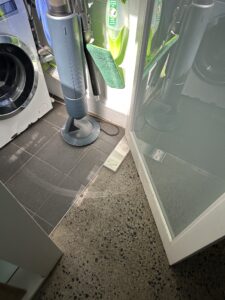
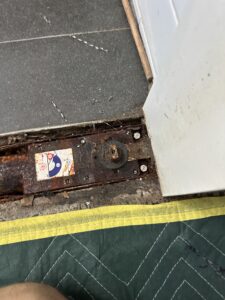
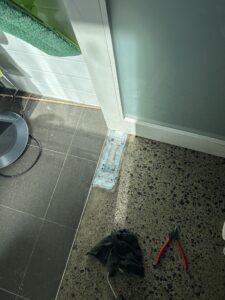
When replacing a floor spring, the existing system should be assessed to ensure the replacement is correctly matched to the door and its operating requirements. Correct installation is also critical to the service life of a floor spring. The floor spring box and surrounding penetration must be appropriately sealed following installation to prevent water and moisture from entering the box. Water penetration can cause corrosion and deterioration of the internal components and hydraulic mechanism, potentially leading to premature failure of the floor spring.
Door Closers for Hinged Doors
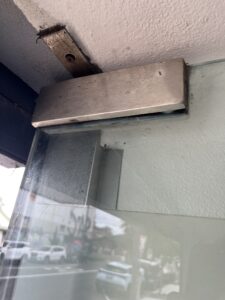
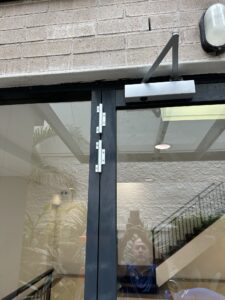
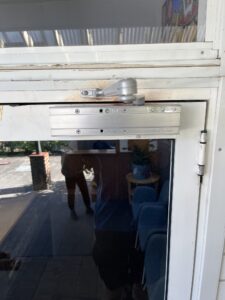
Door closers fitted to hinged doors are designed to control the movement of the door and return it to the closed position after opening. They are available in a range of configurations and capacities, from lighter-duty closers for residential and low-traffic applications through to heavy-duty commercial closers designed for larger, heavier doors and frequent use. A door closer’s suitability depends on factors such as door size and weight, frequency of use, wind conditions, opening force, closing speed and latching requirements. Hydraulic door closers typically provide adjustable control over the closing and latching speeds, with some models also incorporating backcheck, delayed action or hold-open functionality. A closer that is incorrectly sized or adjusted can result in excessive opening force, slamming, failure to latch or premature wear to the closer and associated door hardware. Assessment of the complete door and hardware configuration is therefore important when repairing or replacing a door closer.

– Read Less
To speak to us please call 0477 006 654 today or email us for a quote